Durability is the ability to remain useful under the conditions you actually create. A heavy pan is not automatically durable, and a lightweight product is not automatically disposable. A sturdy object that is too awkward to lift, clean or store may be a poor long-term choice. Begin with your task, then examine the specific ways a product could stop doing it.
Our comparison method does not turn appearance into a predicted lifespan. Without controlled testing, a statement such as “lasts twice as long” is usually more certainty than the evidence supports. We instead look for inspectable construction, manageable care and a plausible route through ordinary wear.
Inspect where the load travels
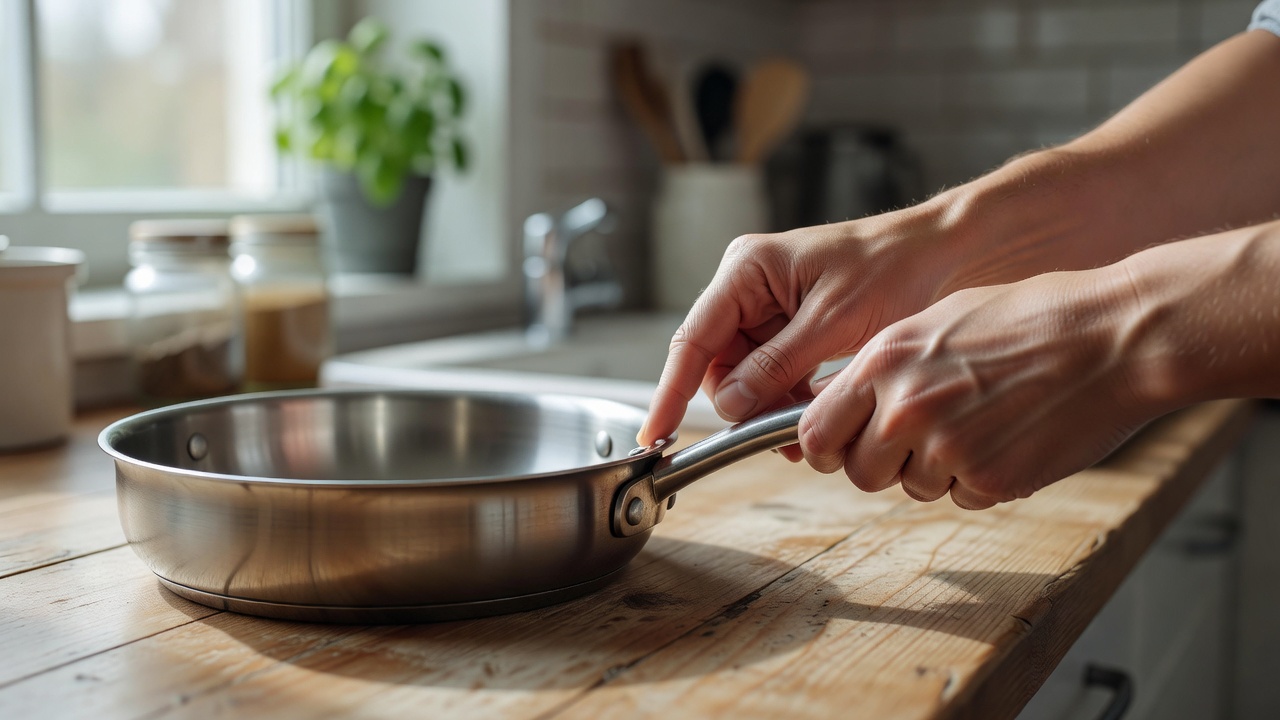
Find the points where force concentrates. On a chair, inspect leg joints, stretchers and the seat attachment. On a saucepan, inspect the handle fixing and whether the base sits flat. On a bag, look where straps meet the body and where seams meet corners. A beautifully finished broad surface tells you little about these stressed connections.
Check for movement, uneven gaps, exposed sharp edges or a fixing that cannot be reached. A joint that moves when it should be rigid deserves a question. Conversely, a part designed to flex should not be judged as faulty simply because it moves. Read the instructions or ask the maker what normal operation looks like.
Compare the failure mode, not the material label
Consider two ordinary cookware approaches. An uncoated stainless steel pan avoids a cooking-surface coating that can wear away, but food release depends on technique, and heat distribution depends on construction. A coated pan can suit delicate cooking and a low-effort cleaning routine, but its coating introduces an additional wear limit. Neither description proves that every example in one category outlasts every example in the other.
| Criterion | Uncoated stainless steel | Coated aluminium |
|---|---|---|
| Likely wear concern | Handle attachment, distortion, damaged layered base | Coating damage, handle attachment, distortion |
| Care burden | May need soaking and cooking-technique adjustment | Needs utensils, heat and cleaning methods compatible with its coating |
| Repair question | Is the handle separately replaceable? | Can parts be replaced, and what happens when the coating wears? |
| Compatibility | Check the exact hob and oven specifications | Check the exact hob and oven specifications |
When buying in person, examine the exact item rather than relying on a showroom example from another size or range. When buying online, request close photographs and a model-specific manual. A vague product-family claim should not substitute for information about the object you will receive.
Make the cost assumptions visible
A simple comparison is total expected ownership spending divided by expected uses. Include purchase cost, delivery, necessary accessories, consumables, maintenance and foreseeable repairs. Leave resale value out unless you have a credible reason to include it. This is a planning tool, not a prediction of future prices or lifespan.
For illustration only, an item costing 60 currency units and used 300 times has an initial purchase cost of 0.20 per use. If a necessary repair adds 15 units, that becomes 0.25 per use over the same 300 uses. The example is arithmetic, not evidence that a product will reach that number of uses. Recalculate with a short-use case and a longer-use case; uncertainty should be visible.
Check whether the care routine fits
Maintenance can make a sound product a poor fit for a particular household. A knife that needs immediate drying, a textile that cannot tolerate your usual wash, or a filter requiring frequent attention brings ongoing work. Read those requirements before purchase. If the routine is unrealistic, choose something compatible rather than assuming future habits will change.
Keep instructions and purchase records in one accessible place. Inspect stressed connections occasionally, follow manufacturer maintenance intervals and stop using equipment that shows a safety-related fault. Do not tighten, lubricate or modify an unfamiliar mechanism without checking the instructions; the wrong intervention can damage it.
A final durability decision
- Can you describe the job and likely frequency of use?
- Have you checked the most stressed connection, not only the finish?
- Are the care requirements practical for your home?
- Can wear parts be found and fitted at a reasonable total cost?
- Would keeping your current item already meet the need?
If several answers remain unknown, pause. Uncertainty is not proof of poor quality, but it is a reason to avoid paying extra for an unsupported durability claim. A modest, well-understood object can offer better value than an expensive one whose weak points remain hidden.
Stop using an item with structural cracking, electrical damage or another potentially dangerous fault. Cost-per-use calculations never override product recalls or qualified safety advice.