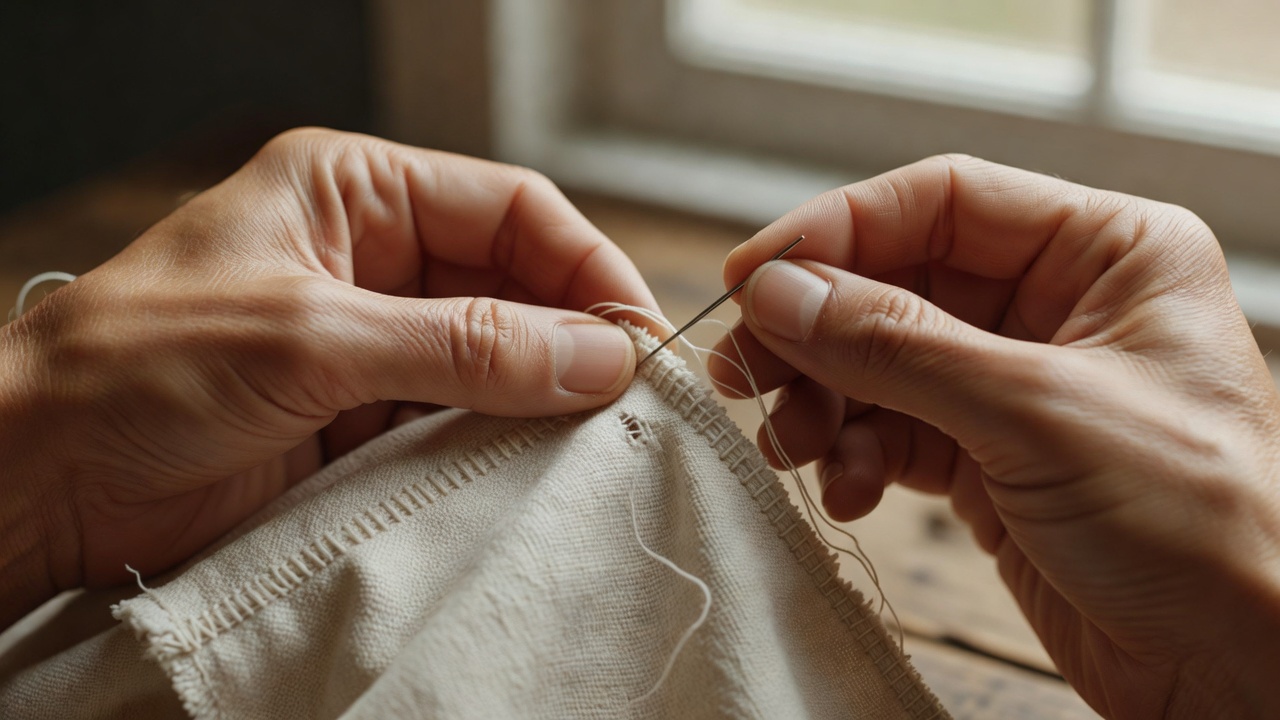
“Solid wood,” “stainless steel” and “natural fibre” sound reassuring. Each describes something useful, but none guarantees a well-made object. Thin steel can distort, solid wood can split at a poorly designed joint, and a natural-fibre cloth can fail at its hem. Examine how the material has been selected, shaped, joined and protected.
Begin with the conditions of use. Will the object get wet, carry weight, meet heat, rub against another surface or need frequent washing? A material can perform well in one setting and poorly in another. The aim is not to find the most prestigious substance; it is to find a construction that fits your routine without demanding unrealistic care.
Textiles: inspect the seam as well as the cloth
Check the fibre composition and care label, then look at the weave or knit and the places where pieces join. Loose threads, skipped stitches and seams already pulling apart deserve attention. A dense feel can suggest substantial construction, but softness or weight alone cannot establish abrasion resistance, shrinkage or colourfastness.
Cotton and linen can work well for many household tasks, while synthetics can offer useful stretch, quick drying or abrasion performance. Blends may combine properties but can complicate recycling and alter care needs. No fibre category is automatically a low-impact or durable choice in every application. Consider how often the item will be washed and whether its care instructions suit your equipment.
For towels, cloths and removable covers, check whether edges are securely finished and whether damage can be patched. A fabric whose normal function depends on a fragile surface treatment deserves a different assessment from one that remains useful as it wears. Ask what the product will be like after repeated cleaning, not just when first unpacked.
Wood: separate the surface from the structure
Solid timber, plywood and veneered panels serve different purposes. Plywood can provide useful stability, while a well-applied veneer uses a thin decorative surface over a substrate. Neither should be dismissed merely for not being solid wood. What matters includes edge protection, moisture exposure, the quality of the core and how the joints carry loads.
Inspect corners, undersides and attachment points. An attractive finish on the top does not reveal whether a fastener has enough sound material around it. Check whether the intended cleaning method is compatible with the finish. Do not assume every scratched surface can be sanded: a thin veneer or coating may be damaged by an approach suitable for solid timber.
Metals and coatings: ask what is doing the work
Stainless steel resists corrosion in many ordinary settings, but grade, finish, environment and care still matter. Aluminium is light and conducts heat well, yet its suitability depends on the design and intended contact conditions. A layered pan uses different materials for different functions; the label on the outside may describe only part of its construction.
Coatings can provide food release, corrosion protection or a particular appearance. They also introduce another surface that may chip, scratch or wear. Ask whether the coating is essential to function, whether the underlying material is suitable if exposed, and what the manufacturer says about damage. Never continue using a compromised product based on a general statement about the base material.
| Product type | Inspect | Ask before purchase |
|---|---|---|
| Household textile | Seams, edge finish, fabric structure | Will its care label fit your washing routine? |
| Wooden furniture | Joints, exposed edges, substrate | What moisture and repair limits apply? |
| Metal cookware | Base construction, handle fixings, coating | What hob, heat and utensil restrictions apply? |
| Plastic household tool | Stress points, flexing sections, replaceable parts | What temperatures and chemicals are permitted? |
Treat certification as a scoped claim
A genuine certification can answer a specific question, not every question. Forest Stewardship Council and Programme for the Endorsement of Forest Certification schemes concern forest-related sourcing claims within their respective scopes. OEKO-TEX STANDARD 100 concerns testing textiles for harmful substances under its criteria. The Global Organic Textile Standard addresses organic fibre processing requirements within its scope. None is a universal promise that a finished product will outlast an alternative.
Check the named scheme, the certificate or label identifier, and whether the claim applies to the whole product or a component. A logo copied into a listing is not enough. Similarly, ISO 9001 concerns a quality management system; it does not establish a particular household product’s service life. A material standard number should be read for what it actually specifies, not treated as an all-purpose quality score.
Make the comparison at the right level
Compare an exact construction with another exact construction. Record the material, joining method, surface treatment, maintenance requirements and plausible failure points. When a seller cannot provide this information, leave the field unknown rather than filling it with an optimistic assumption.
You do not need expert material analysis to make a better decision. A close photograph of a seam, a readable care label and a clear answer about a replacement handle can be more useful than a page of luxury language. And if your current object is sound, suitable and familiar, a newly fashionable material is not a reason by itself to replace it.